











Article: The connective power of music
The connective power of music
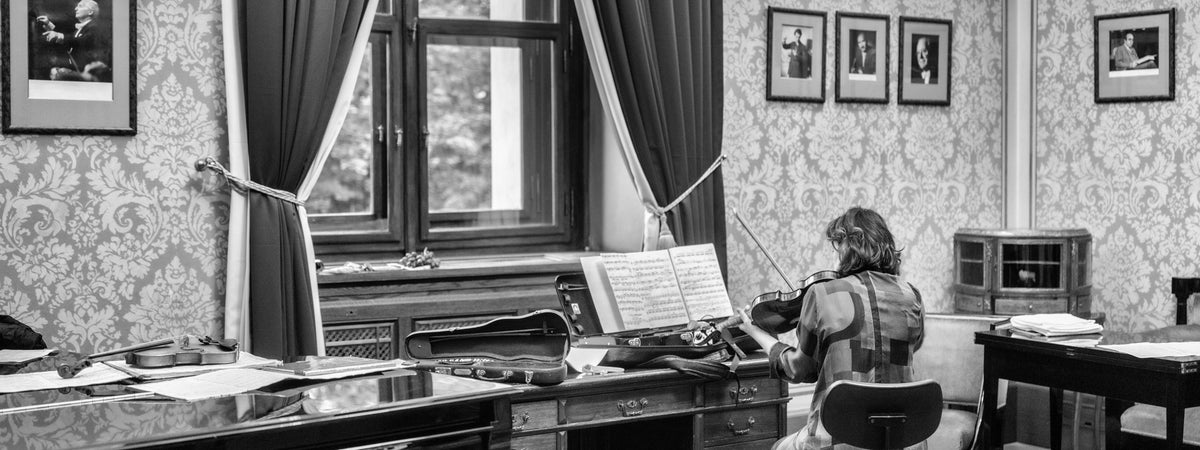
Classical music's barefoot disrupter: violinist, conductor and composer Patricia Kopatchinskaja fled Soviet Moldova for Vienna in 1989 and has since been world-premiering concertos and breaking conventions. The New York Times recognised her 'rare expressive energy and disarming informality'. We spoke about the connective power of music, the drama of the unexpected, and why beauty can be dangerous.

© Marco Borggreve
ELLIS FAAS: What can you say through music that you cannot say with words?
Patricia Kopatchinskaja: You can use many, many words to say one thing, but mean something completely different, or actually say nothing at all. There is a saying that in music “the melody makes the sense”. I think that only our instinct is in charge of sorting out the truth. Like the rats that leave the boat before the storm – they didn't check the weather forecast; they just know what to do. Music is all about waking these unspeakable senses.
EF: People seem to be born with a need to express themselves through melody and rhythm. Does that make folk music the most natural form of music – and what role does folk music still play in your musical life today
PK: My parents are folk musicians; it's the language of my childhood. Folk music is the base of all music – it's utterly human and seeks a sense of connection. It makes people smile, dance and forget their worries for a moment while dancing at a summer feast in a small mountain village. But it also comforts people, or brings them to tears. I find myself rooted in it, especially when playing contemporary music: abstract as it is, there is always something we can connect to.
EF: You've said that growing up as an artist is rather counterproductive, and that your goal is to approach music with the open, non-judgemental eyes of a child. What do you actually do – or refuse to do – to stay naive?
PK: When I feel routine coming, I try to find my empty space, reset, wonder, search for the unheard, and catch a splinter for my next expedition.

© Marco Borggreve
EF: But classical music is steeped in tradition, convention and restricting dos and don'ts. Why do you think people feel awkward, or even offended, when they hear and see music performed differently from what they are used to?
PK: This is really a core question, one I have asked myself all my life. I really have no idea… It is very hard to shock a theatre audience, because nearly everything has already happened on that stage. But in classical music, even wearing a different colour of socks is already a shock for our audience! We have made classical music so unrecognisably polite and polished, and everything has to be faultless and golden. It is time to brush off the shine that is hiding what is actually in the score: the drama of the unexpected.
EF: Many of the greatest composers – Beethoven, Mahler, Stravinsky – utterly shocked their contemporaries, but over time we have grown used to the new paths they opened, and the shock has worn off. As an interpreter, you play the exact same notes as a colleague from, sometimes, centuries ago. How do you make those notes relevant, or even shocking, to today's audience?
PK: Our core repertoire is a canon of pieces we’ve heard so often that we no longer feel the excitement as much as at the time they were written – unless the interpreter manages to cut right to the bone, no ifs or buts. But that's bordering on magic. Keeping music playful and joyful is essential; there are so many ways to understand a piece. Nobody “owns” the music.

© Marco Borggreve
When I look at the score, what I hear is my very personal encounter with the piece, with the composer and the time – not only the time it was written, but also with our time, the now. How can I connect to it, and what is relevant for me to say? It's a conversation with something that develops and changes over time. For instance, what do I want to say when I play Schumann's Violin Concerto? In 1853, it was written as a farewell – so: what does “farewell” mean to me today? Well… Isn't a farewell just the state of mind we find ourselves in when we see and hear how, and in which direction, society is moving across the globe? Let us not bid farewell to the environment that has given us everything, and which has now been completely drained and abused by the most intelligent and, at the same time, the most stupid species – humankind.
EF: “Rawness” isn't something many people associate with classical music, which - as you said - can seem extremely polished and controlled, with little room for sounds that are no longer considered beautiful. Does composing give you more room to convey raw emotion?
PK: Composing is about everything: sound, how instruments interact, the structure of the musical story, and those kinds of core decisions. But the ultimate result is in the hands of the interpreters. That's why the same piece can have so many faces. Beauty itself can be dangerous – it can cover up the truth. A beautiful voice can make music flourish, but it can also distract and hide what the music is really saying.
EF: The press sometimes calls you a “wild child”. Is there a cost to being the person everyone expects to be unorthodox every single night?
PK: My partner says I am the most normal person in the world. For me, it is the most normal thing to play music in a way that at least I am not bored. Music is not a monument; it has its life every time – sometimes out of control, sometimes opening new doors – and it would be a sin not to explore new insights. It's an endless game. It's not about perfection, it's a story, a situation where things can go wrong. Like in sport: the final result is unknown, and that makes the match all the more exciting. If you seek perfection, it becomes rigid.

© Marco Borggreve
EF: Music becomes relatable when the musician allows a certain naked vulnerability to show. But how can you show vulnerability without falling apart? Have you ever broken, and if so, how did you deal with it?
PK: Vulnerability makes me stronger. If I didn't feel this way, I couldn't do this job for very long. It's surgery on my soul without anaesthesia. But truly magical moments happen extremely seldom; that's why they are so precious. How I deal with it is that I fall asleep and then start again; I break, cry and smile, then continue. There is no other way.
EF: If there is one motto you try to live by, what would it be?
PK: Stay curious.

© Marco Borggreve
For more info and concert dates: patriciakopatchinskaja.com
Follow Patricia on Instagram
And do check out her new album PatKop & Say which also contains one of her compositions.