



Article: Wonder, curiosity and the human touch
Wonder, curiosity and the human touch
A Conversation with Golnar Roshan
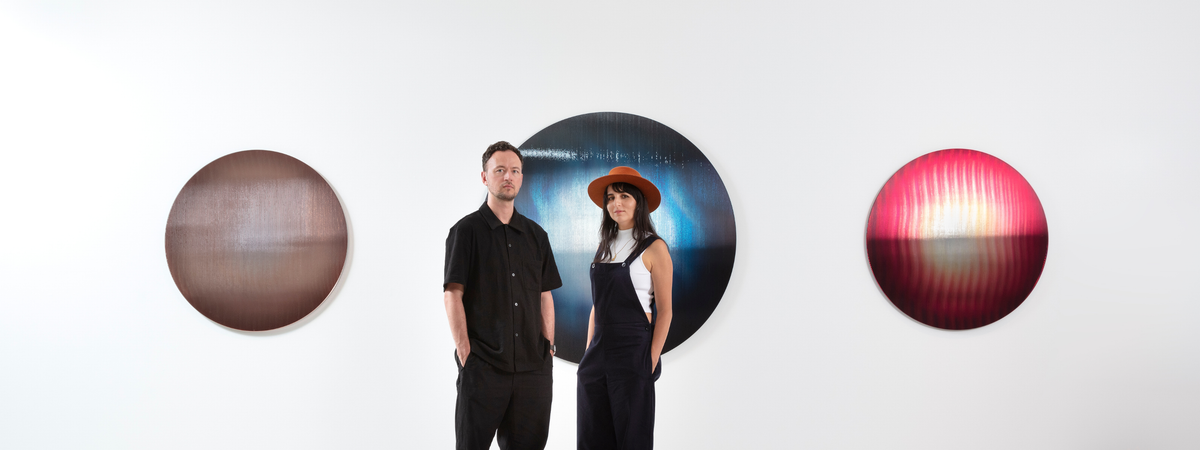
Half of design duo Rive Roshan, Golnar Roshan works together with her husband, Ruben de la Rive Box, on transient, light-filled installations and sculptural pieces that sit somewhere between art, design and technology. We chatted about curiosity, wonder, freedom, and why the human touch matters more than ever.

Milan 2025: Chiaroscuro | Photography: Design & Practice
ELLIS FAAS: In preparing for this conversation, one word kept popping up in everything we read about you: curiosity. How does curiosity show up in your personal life and your work?
GOLNAR ROSHAN: It's definitely something that's really deep in our work. We always talk about the idea of curiosity, about wonder, and about paying attention to the moments in our lives and surroundings that make us wonder. I think it's something many people lose as they get older, as we settle into the daily grind of life. Children really have this curiosity and wonder, and unfortunately, in society, it sometimes gets suppressed.
We find it really important to tap into moments that trigger us to feel, and to just take a moment and try to understand why they trigger you internally. That feeling is quite magical, and we try to recreate these moments through our work. At night you can be walking along the canals, and suddenly this reflection is in the water, moving with the ripples, and that really stops you along your path. These are experiences that make us really human, that connect us with our surroundings and with each other. As a bit of a goal in our lives, and also as creatives, we try to recreate these moments, not in a super functional way, but really in an inspirational way.
EF: When we spoke to the Australian brand Song for the Mute, they also explained how their own personal memories and experiences drive the narrative of their designs. How is this process for you: starting from a memory, an experience, perhaps something from your own cultural heritage, in your case Iranian-Australian?
GR: I come from a family who had to leave Iran around the time of the revolution, in the eighties, so I grew up with an almost dreamlike understanding of my heritage and culture. It's all derived not from what it is now, but from the poetry, the literature, the art, the food, all the positive things, and from a longing to reach an understanding of that beauty. Ruben, meanwhile, has been very much exposed to the cultural and art side of Dutch culture. We often talk about the light in the paintings of the Dutch sky, how low the clouds look in those paintings. These are those magical moments in life that these painters were trying to capture on canvas. It was their way of holding a moment in time. We feel we should continue to do that, to capture this beauty that surrounds us, because the world is just so divided and so complex, and we're so distracted by so many things. In essence, I think the most important thing is to be very close to our core.

Milan 2025 Alcova: Sun Catcher | Photography: Design & Practice
EF: Is there an aspect that is usually the starting point: the light, the material, the space?
GR: The starting point is always the feeling and the experience we're trying to create for somebody else to have. It never happens that we make a panel and then figure out afterwards why we did it. When we do a self-initiated project, we first question what we are trying to manifest as an idea, before we think about what we're going to put out there. The process is very experiential.
EF: The colours of our brand are embedded in the human body. Your work seems strongly connected to nature.
GR: It's nature, but also human nature. What we're really interested in is the internal aspect of the human being: what triggers people inside. Indeed, the work itself changes with the light. In the afternoon, when the sun sits low, its surface catches the light and a whole piece can turn a deep orange. As the hours pass, the colours shift with it, and the piece is never quite the same from one moment to the next. So yes, it's true: it's about the interaction of nature, but not just the nature around us; also the nature within us.

Voices Vessels (left) and Freedom Vessels (right)
EF: With your vessels, weren't you also inspired by the female form?
GR: Yes, this was quite a personal project. Around the time of the Woman, Life, Freedom movement in Iran, we felt we needed to do something to express this idea of freedom, of women becoming emancipated, especially there, where they are so restricted. Ruben and I kept having discussions about it: what could we do? There was nothing we could really do, except talk about this idea of freedom. So we created these vessels out of 3D-printed sand: symbols of freedom, symbols that represent dance and movement, expressive vessels that capture this dream we have for these women.
EF: Are you inspired more often by those almost political moments in life?
GR: Yes, and the sad thing is, we’re not always allowed to talk about it. In most cases, clients and institutions want to remain completely neutral, which makes it difficult to share a deeper narrative. What we believe in at the core is humanity, and what we're really against is division. So with our self-initiated pieces, where we have the freedom to create whatever we want, we do reflect on our current time. The question we ask ourselves most is: how can we make people feel more connected? We're all drawn to this idea of awe: a beautiful sunset, we all find that beautiful.

Photography: Lucas Clemens and Nanda Hagenaars
Central image courtesy of Gallery Sally Dan-Cuthbert
GR: Our recent installation at Milan Design Week was a dance of lights behind glass, connected again to my heritage. At the time, the government in Iran was killing people in the streets; tens of thousands murdered just for wanting to be liberated. We collaborated with an AI singer, called Nava, created by Farbod Mehr an artist in London. Nava became really big because she would sing anthems of resistance that have existed throughout history in Iran. We used this song for the choreography of the lights, and it's so soulful, even though she's AI. That's what we found really interesting: our work sits between nature and technology. She wasn't real, and yet so many people were able to connect to this voice; people were crying, people would approach us to talk about it. Sometimes we'd go into the story of why we made it; in others, it was purely about the experience.

Freedom Vessels, courtesy of Gallery Sally Dan-Cuthbert (left) and Horizon Windows (right)
EF: Talking about AI, we love everything tactile, physical, real and raw. But the world around us is changing, and there are a lot of cosmetic brands now using AI-generated content to show makeup and the like. I hope we can stay away from that. For us, the human aspect is the most important thing. It's why we do what we do.
GR: Exactly. But I'm not saying we shouldn't use AI at all. In certain ways it can be very practical. We're also just in a phase where everyone's trying to figure out what works and what doesn't. I do notice there's a lot more rawness coming out as a result of it. I think we're probably moving towards a phase where we will actually crave the humanness more than ever. We're in between right now.
EF: Yes, we see the analogue world coming back at the same time: people wanting to go to a store again instead of buying online, listening bars popping up where you sit together around one DJ set instead of pressing play on Spotify all day… Let's hope that when people start connecting again, it brings some peace to the world.
GR: Exactly. I think we all play our little parts. The event you hosted earlier this year, bringing together creatives from all kinds of disciplines and backgrounds, was one of those intimate moments. A lot of other brands are trying to create them, but they can't get the intimate realness into it. If those genuine moments work like it did for you, I think they are just so important, because it's really hard to make something real.
For more about Rive Roshan: riveroshan.com and @riveroshan
Blog opening image courtesy of Gallery Sally Dan-Cuthbert

